When a man starts noticing the signs of declining testosterone — fatigue, reduced drive, changes in body composition, diminished vitality — the question of what to do about it leads almost immediately to a fork in the road: prescription testosterone replacement therapy (TRT) on one side, natural health products on the other.
These are not the same category of intervention. They operate through different mechanisms, are governed by different regulatory frameworks, carry different risk profiles, and are appropriate for different populations. Understanding the distinction matters — both for making an informed personal decision and for having a productive conversation with a physician.
What Testosterone Replacement Therapy (TRT) Is
TRT introduces exogenous (external) testosterone directly into the body — bypassing the body’s own production system and replacing the hormone directly. It is available in several formulations: topical gels, intramuscular injections, subcutaneous pellets, and, more recently, oral capsules that use lymphatic delivery to bypass first-pass liver metabolism.
TRT is a prescription medication. In Canada, Health Canada approves testosterone products for men with documented low testosterone caused by specific medical conditions — primary or secondary hypogonadism with a confirmed clinical and biochemical diagnosis. Age-related testosterone decline, on its own, does not constitute an approved indication under current Health Canada labeling, though clinical practice is evolving as international evidence accumulates.
When testosterone is supplied exogenously, the body’s own production typically shuts down. The hypothalamic-pituitary-gonadal axis receives negative feedback and reduces or ceases its own signalling to the testes. This is why discontinuing TRT requires a careful tapering approach, and why it can affect fertility — exogenous testosterone suppresses sperm production along with endogenous testosterone synthesis.
What Natural Health Products Do
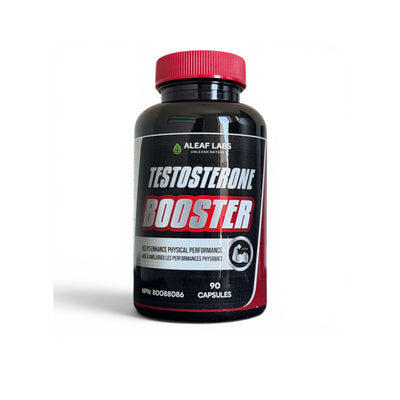
Licensed natural health products — like Aleaf Labs Testosterone Booster, which carries Health Canada NPN 80088086 — do not introduce testosterone into the body. They contain botanicals, micronutrients, and plant-derived compounds that support the body’s own hormonal environment through various indirect mechanisms:
- Supporting the HPG axis: Ingredients like Tongkat Ali (Eurycoma longifolia) appear to modulate the hormonal signalling pathway that governs testosterone production, helping the body produce more of its own testosterone.
- Aromatase inhibition: Eurycomanone, the primary bioactive compound in Tongkat Ali, inhibits the enzyme that converts testosterone into estrogen, preserving more active testosterone.
- Cortisol modulation: Adaptogenic botanicals like Tongkat Ali, Panax Ginseng, and Siberian Ginseng have documented cortisol-reducing effects. Since cortisol suppresses testosterone production, reducing it supports the hormonal environment.
- Micronutrient support: Zinc is a cofactor in multiple steroidogenic enzymes. Deficiency is associated with reduced testosterone; correction of deficiency supports endogenous production.
The key distinction: NHPs work with the body’s existing system. They do not suppress endogenous production, do not affect fertility in the way TRT does, and do not require a prescription or physician monitoring.
What the Evidence Shows for Each
TRT has extensive evidence for efficacy in clinically hypogonadal men. The TRAVERSE trial, the largest RCT of testosterone therapy ever conducted, enrolled over 5,200 men with documented deficiency and demonstrated improvements across multiple outcomes, without the cardiovascular risk originally feared. The College of Family Physicians of Canada notes that testosterone therapy may increase lean body mass by approximately 1.6kg in older men, though effects on sexual function, strength, fatigue, and cognition are more variable and depend heavily on baseline status and severity of deficiency.
Natural health products have a different and more targeted evidence base. The clinical trials on Tongkat Ali consistently show meaningful effects in older men with low or declining testosterone — the population whose endogenous production system is intact but operating below optimal capacity. The effects are more modest than TRT in severely hypogonadal men, but in men with mild to moderate decline, the distinction narrows considerably.
Integrative research has documented that combining lifestyle interventions — resistance training, sleep optimization, dietary patterns — with targeted natural compounds like Tongkat Ali, Panax Ginseng, zinc, and Vitamin D produces “considerable promise” and “favorable safety profiles compared with pharmaceutical interventions, providing sustainable pathways for healthy aging.”
Risk Profiles: A Balanced View
TRT is not without risks. Even following the 2025 removal of the cardiovascular black-box warning, testosterone therapy is associated with modestly elevated blood pressure, increased rates of atrial fibrillation (3.5% vs 2.4% in TRAVERSE), and increased risk of polycythemia (elevated red blood cell count). It requires ongoing physician monitoring of haematocrit, PSA, and blood pressure. It is not appropriate for men with certain conditions, and its effect on fertility requires careful consideration in men who may wish to father children.
Natural health products, used at clinical doses from standardized extracts, have a favorable safety profile in the peer-reviewed literature. The primary safety caveat for Tongkat Ali specifically involves unregulated or contaminated products — not standardized clinical extracts. This underscores the importance of choosing products licensed by Health Canada, which requires evidence of safety and quality as part of the NPN approval process.
Who Should Consider Each
This is not medical advice, and individual decisions should always involve a physician. But the evidence suggests a reasonable framework:
TRT is typically considered for men with documented clinical hypogonadism — confirmed low testosterone on repeated testing, combined with significant symptoms that impair quality of life, and who have ruled out reversible causes. It requires a prescription and physician oversight.
Natural health products are appropriate for men experiencing early or moderate hormonal decline, men who prefer not to suppress endogenous production, men who want to support lifestyle interventions with a licensed supplement, and men who are not yet at the threshold of clinical hypogonadism but are experiencing symptomatic decline.
For many men, the conversation is not “TRT or nothing” — it is “what is the right level of intervention for where I am right now?” The answer to that question begins with knowing your numbers.
References
- Lincoff AM, et al. TRAVERSE Trial. New England Journal of Medicine. 2023;389:107–117.
- College of Family Physicians of Canada. Testosterone supplementation for men. CFP. May 2025;71(5):321.
- Grober ED, et al. Canadian Urological Association guideline on testosterone deficiency in men. PMC8095276. 2021.
- Health Canada. Approval of testosterone undecanoate. Urology Times. June 2026.
- PMC12887910. Integrative Natural Approaches for Age-Related Testosterone Decline. 2025.
- Affinity Whole Health. Hormone Therapy in 2025: A Recap of the Year’s Biggest Breakthroughs. February 2026.
- NIH LiverTox. Tongkat Ali safety profile. October 2024.