If you’ve looked into natural testosterone support, you’ve likely encountered a phrase on product labels that looks something like this: “Tongkat Ali Extract — standardized to 1.5% eurycomanone.”
Most people read past it. Few understand what it means. But this small piece of technical language is arguably the most important piece of information on a Tongkat Ali label — more predictive of whether a product will actually work than the brand name, the price, or the marketing copy surrounding it.
Here is a plain-English explanation of what standardization means, why eurycomanone is the compound that matters, and what to look for (and avoid) when choosing a Tongkat Ali supplement.
What Is Standardization?
Plant extracts are chemically complex. A single plant root may contain hundreds of individual compounds, present in varying concentrations depending on the plant’s species, growing conditions, harvest time, and age. When a manufacturer produces an extract from that root, the resulting product will contain all of those compounds — but in proportions that vary from batch to batch, supplier to supplier, and year to year.
Standardization is the process of ensuring that a specific bioactive compound is present at a guaranteed minimum concentration in every batch, regardless of natural variation in the raw material. A product standardized to 1.5% eurycomanone guarantees that for every 100mg of extract, at least 1.5mg is the specific compound with documented biological activity.
Without standardization, you have no way of knowing how much of the active compound you are actually consuming. You might be taking an expensive capsule of plant fibre with negligible bioactive content.
Why Eurycomanone Specifically?
Tongkat Ali root contains numerous compounds across several chemical families: quassinoids, glycosaponins, alkaloids, and eurypeptides. Of these, the quassinoid eurycomanone has received the most scientific attention as the primary bioactive responsible for Tongkat Ali’s hormonal effects.
The documented mechanisms of eurycomanone include:
- Aromatase inhibition: Eurycomanone inhibits the enzyme aromatase, which converts testosterone into estradiol (estrogen). By blocking this conversion, it preserves more circulating testosterone in its active form. This mechanism is well-characterized in vitro and is consistent with the testosterone-supporting effects documented in human trials.
- HPG axis modulation: Eurycomanone and related quassinoids appear to influence the hypothalamic-pituitary-gonadal axis, the central hormonal communication pathway governing testosterone production. The precise mechanism is still being clarified, but the downstream effect — increased endogenous testosterone — has been replicated across multiple human studies.
- Cortisol modulation: Human trials consistently document reductions in salivary and urinary cortisol following standardized Tongkat Ali supplementation. This is clinically relevant because cortisol directly suppresses testosterone production, and the two hormones are in biochemical competition.
Eurypeptides — a separate class of bioactive compounds in Tongkat Ali — are also believed to support testosterone through the CYP17 enzyme pathway, increasing the conversion rate of hormonal precursors into androgens. A comprehensive extract preserves both eurycomanone and eurypeptides rather than isolating one at the expense of the other.
The Market Reality: Why Standardization Matters More Than You Think
Independent laboratory analysis conducted in 2025 tested a range of commercially available Tongkat Ali supplements for actual eurycomanone content. The findings were striking.
Potency varied by more than 100-fold between products. The best-performing product contained 12mg of eurycomanone per dose. Several popular products contained less than 0.5mg. Multiple products — some carrying premium pricing and confident marketing claims — contained no detectable eurycomanone whatsoever.
This is not a marginal quality difference. A product containing 0.2mg of eurycomanone and a product containing 12mg are not different strengths of the same intervention. They are functionally different products. The clinical trials that documented testosterone-supporting effects used standardized extracts with verified bioactive content — not commodity Tongkat Ali powder of unknown composition.
This explains the widespread consumer experience of “Tongkat Ali doesn’t work for me.” In many cases, the product consumed had no meaningful amount of the compound that the science actually studied.
Understanding the Numbers: What 1.5% Actually Means in Practice
At a standardized 1.5% eurycomanone concentration:
- A 100mg serving contains 1.5mg of eurycomanone
- A 200mg serving contains 3mg of eurycomanone
- A 400mg serving contains 6mg of eurycomanone
Clinical trials demonstrating meaningful testosterone-supporting effects have generally used 100–400mg of standardized Tongkat Ali extract per day. The human trials showing the most consistent results used extracts standardized to 0.8–2% eurycomanone — the range within which 1.5% falls.
Higher standardization percentages (e.g. 2%, 5%, 10%) are available. Whether higher eurycomanone concentrations confer proportionally greater benefit in humans is not conclusively established, and some researchers argue that the full-spectrum profile of Tongkat Ali — including eurypeptides and other co-factors — contributes to its effects in ways that isolated high-percentage extracts may not fully replicate.
What to Look for on a Label
When evaluating a Tongkat Ali product, the following label elements provide meaningful quality signals:
- Standardization percentage disclosed: If a label does not specify the eurycomanone percentage, assume there is no standardization guarantee.
- Species specified: The product should specify Eurycoma longifolia (Yellow Tongkat Ali) — the species with the most robust human clinical trial evidence and the highest testosterone-supporting effects in comparative research.
- Third-party testing or COA availability: A Certificate of Analysis from an independent laboratory confirming actual eurycomanone content is the gold standard for verification.
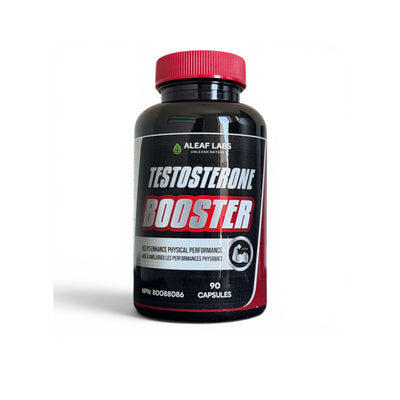
- Regulatory licensing: In Canada, a Natural Product Number (NPN) from Health Canada indicates the product has been assessed for safety and quality. Aleaf Labs Testosterone Booster carries NPN 80088086.
- GMP-certified manufacturing: Good Manufacturing Practice certification ensures consistent production quality and contamination controls.
The Bottom Line
Eurycomanone standardization is not a technicality — it is the mechanism through which a Tongkat Ali product does or does not deliver what the clinical research documented. A product without verified standardization is not a weaker version of a standardized product. It is a different product altogether.
When you see “standardized to 1.5% eurycomanone” on an Aleaf Labs label, it means that the specific compound with documented aromatase-inhibiting, cortisol-modulating, and testosterone-supporting properties is present at a guaranteed concentration in every capsule — verified, consistent, and aligned with the evidence base.
That is what you are paying for. And it is worth understanding.
References
- PricePlow Blog. Independent lab analysis of Tongkat Ali eurycomanone content across commercial products. June 2025.
- Nootropics Depot. Tongkat Ali 2% Eurycomanone: Full Spectrum Standardization. 2025.
- Examine.com. Research Breakdown on Tongkat Ali: Mechanisms and Evidence. September 2025.
- Tambi MI, et al. Standardised water-soluble extract of Eurycoma longifolia as testosterone booster for managing men with late-onset hypogonadism. Andrologia. 2012;44(S1):226–230.
- Leisegang K, et al. Systematic review and meta-analysis of Tongkat Ali RCTs. 2022.
- WHYZ. Tongkat Ali: Benefits, Dosage & Safety. March 2026.
- Akarali. Scientific Evidence Supporting Tongkat Ali as a Testosterone Booster. March 2026.
- NIH LiverTox. Tongkat Ali. October 2024. ncbi.nlm.nih.gov/books/NBK609015