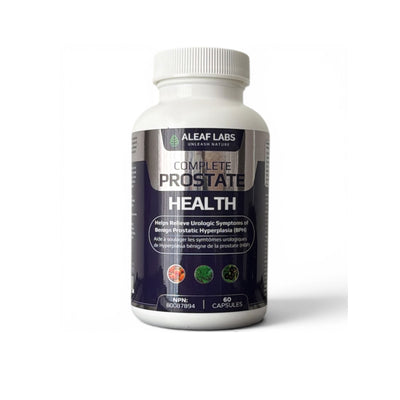
This is a clinical review of the six medicinal ingredients in Complete Prostate Health (NPN 80087894): what each one is, what the human trial evidence shows, and how our dose compares to the dose used in that research.
It is written for men who would rather check a formula than be sold one. Where the evidence is weak, where the plant part we use differs from the plant part the trials used, or where our dose sits below the trial dose, this article says so. A review that only flattered the product would not be worth your time.
How to Read This Formula
Complete Prostate Health is taken as two capsules daily. The label states amounts per capsule, so the daily amount is double each figure below. Where an ingredient is an extract, the ratio matters: a 10:1 extract is concentrated from ten times its weight in raw herb, which is why 80 mg of a 10:1 nettle extract carries a quantity crude equivalent (QCE) of 800 mg. Extract milligrams and raw-herb milligrams are not interchangeable, and any honest comparison has to keep them straight.
Ingredient-by-Ingredient Clinical Review
1. Saw Palmetto — Serenoa repens, fruit
Mechanism: A lipophilic extract of the saw palmetto berry. Proposed actions include inhibition of 5-alpha-reductase, the enzyme that converts testosterone to DHT, the androgen driving prostate tissue growth; anti-inflammatory activity via COX inhibition; and alpha-adrenergic effects on urethral tone.
Evidence: Genuinely split, and the split tracks with extract type. A pooled analysis of 18 randomized trials in 2,939 men found significant improvement in urinary symptom scores and peak flow versus placebo, and a direct comparison found a standardized hexane-processed extract performed comparably to the standard prescription alpha-blocker with fewer sexual side effects. But two large NIH-funded trials, STEP and CAMUS, found no difference from placebo even at double the standard dose. Those used a different commercial preparation. Cochrane's own assessment is negative.
Our position: This is the strongest dose in the formula. Trials typically used 320 mg/day of standardized extract; we deliver 400 mg/day. That is the one ingredient here where we are comfortably at trial level. We are not going to tell you the saw palmetto debate is settled, because it is not.
Wilt et al. — Meta-Analysis (JAMA 2000) Barry et al. — CAMUS (JAMA 2011)2. Stinging Nettle — Urtica dioica, herb top
Mechanism: Nettle contains lectins, polysaccharides and lignans proposed to modulate sex hormone binding globulin and reduce prostatic inflammation.
Evidence, and the caveat that matters most: The randomized trials in BPH used nettle root. A trial in 558 men used root extract at 120 mg twice daily and found significant IPSS improvement; the well-known combination trial that matched a prescription 5-alpha-reductase inhibitor over 48 weeks also used root alongside saw palmetto.
We use the herb top, not the root. Herb top and root are different plant parts with different constituent profiles, and it would be misleading for us to point at root trials as evidence for what is in our capsule.
Our position: We are citing the root literature here for context, not as support for our own ingredient, and we want that stated plainly rather than buried. This is a formulation gap, not a marketing point, and it is on our list to address.
Sokeland — Sabal/Urtica vs. 5-ARI (2000)3. Pygeum — Prunus africana, trunk bark
Mechanism: Bark extract containing phytosterols, pentacyclic triterpenoids and ferulic esters, with anti-inflammatory and anti-proliferative activity in prostate tissue.
Evidence: The strongest evidence base of anything in this formula. A meta-analysis of 18 randomized controlled trials in 1,562 men found pygeum improved nocturia by 19%, reduced residual urine volume by 24%, and increased peak urine flow by 23%, with a side-effect profile comparable to placebo.
Our position, stated against our own interest: Those trials used roughly 100–200 mg/day of standardized bark extract. We deliver 50 mg/day. That is between a quarter and a half of the studied dose. The ingredient with the best evidence in this formula is also the one where we are furthest below the trial range, and we would rather you read that here than work it out yourself from the label.
Ishani et al. — Pygeum Meta-Analysis (2000)4. Pumpkin — Cucurbita pepo, fruit
Mechanism: A source of plant sterols proposed to influence androgen activity in prostate tissue.
Evidence, stated honestly: The BPH research on Cucurbita pepo used pumpkin seed preparations, typically around 500 mg/day of a soft extract. Our label specifies fruit. And even setting the plant part aside, the evidence is the weakest here: the GRANU study, the largest trial of pumpkin seed in BPH at 1,431 men over 12 months, missed its primary endpoint. It did not separate from placebo on the measure it set out to move. An earlier trial did show benefit and a meta-analysis of the two found quality-of-life improvement, so the picture is mixed — mixed in a way that does not favour us.
Our position: A supporting phytosterol source, not a driver of this formula. If you find a product built primarily around pumpkin, be sceptical of it.
Vahlensieck et al. — GRANU (Urol Int 2015)5. Citrus Bioflavonoids
Mechanism: Bioflavonoids, of which quercetin is the most studied, have anti-inflammatory and antioxidant activity in prostate tissue, with effects on NF-κB and MAPK inflammatory signalling demonstrated in preclinical models.
Evidence, with an important caveat: The randomized evidence for bioflavonoids in prostate health is in chronic prostatitis / chronic pelvic pain syndrome, not BPH. A placebo-controlled trial found quercetin improved symptom scores by 35% versus 7.2% for placebo in men with CP/CPPS. Those trials used around 1,000 mg/day of quercetin specifically.
Our position: We are not claiming BPH trial evidence for this ingredient, because there is none worth citing, and our 60 mg/day of mixed citrus bioflavonoids is not comparable to 1,000 mg/day of isolated quercetin. It is included for the inflammatory component of prostate discomfort, on rationale rather than on trial data.
Shoskes et al. — Quercetin in CP/CPPS (1999)6. Zinc
Mechanism: The prostate holds the highest zinc concentration of any organ in the body. Zinc participates in 5-alpha-reductase regulation and apoptotic signalling, and prostatic zinc is markedly depleted in diseased tissue.
Evidence: Largely epidemiological and biochemical rather than randomized. Adequate zinc status is associated with normal prostate function; no large RCT shows zinc supplementation alone improves BPH symptoms.
Our position: 30 mg/day sits at the upper end of the 10–30 mg range used in prostate-related supplementation research. Worth saying in the other direction: some epidemiological work associates very high long-term intake, above 75 mg/day, with increased risk. More is not better with zinc, and if you take another zinc-containing supplement you should count this one in your total.
Where the Beta-Sitosterol Comes From
Beta-sitosterol has among the cleanest evidence in this category: a Cochrane review of four placebo-controlled trials in 519 men found it improved IPSS symptom scores by a weighted mean of 4.9 points and increased peak urine flow. You will notice it is not on our label.
That is because we deliver phytosterols through saw palmetto, pygeum and pumpkin rather than as an isolated extract. The argument for doing it that way is that whole-plant extracts bring additional mechanisms — 5-alpha-reductase and aromatase modulation, anti-inflammatory activity — that an isolated sterol does not.
The argument against, which we will make for you: those Cochrane trials used 60–130 mg/day of pure beta-sitosterol. Our pygeum is standardized to 13% phytosterols at 50 mg/day, which is roughly 6.5 mg of phytosterols from that source. We do not publish a total phytosterol figure for the formula, and until we do, nobody — including us — can claim it reaches the Cochrane range. If isolated beta-sitosterol at a trial-matched dose is what you want, products built around exactly that exist, and we would rather you bought the right thing than the wrong thing from us.
Dose Comparison: Trial Doses vs. Complete Prostate Health
| Ingredient | Typical trial dose | Ours, per day | How we compare |
|---|---|---|---|
| Saw palmetto (fruit) | 320 mg/day standardized | 400 mg (10:1) | At or above trial level |
| Stinging nettle | 240–600 mg/day, root | 160 mg (10:1), herb top | Different plant part; below trial dose |
| Pygeum (bark) | 100–200 mg/day | 50 mg | Below trial range |
| Pumpkin | ~500 mg/day, seed | 100 mg, fruit | Different plant part; below trial dose |
| Citrus bioflavonoids | 1,000 mg/day quercetin (CP/CPPS, not BPH) | 60 mg mixed bioflavonoids | Not comparable; no BPH trial basis |
| Zinc | 10–30 mg/day | 30 mg | Top of the studied range |
What This Formula Is, and What It Is Not
Read that table honestly and it says this: saw palmetto is at trial strength, zinc is at the top of its range, and the remaining four ingredients are either below the doses used in the research, drawn from a different plant part than the research used, or supported by evidence from a different condition.
What the formula is: a six-ingredient, multi-mechanism phytotherapy with a genuinely strong saw palmetto dose, every amount printed, no proprietary blend, and a Health Canada licence behind the claim it makes.
What it is not: a formula in which every ingredient matches its clinical trial dose. We would rather tell you that than have you discover it by reading the label against the literature, which is exactly what we have just done for you.
What Health Canada Licensed Us to Say
Complete Prostate Health holds NPN 80087894. The authorized claim reads:
“Used in Herbal Medicine to help relieve the urologic symptoms — weak urine flow, incomplete voiding, frequent daytime and night-time urination — associated with mild to moderate benign prostatic hyperplasia.”
That sentence is the only outcome claim we make for this product. An NPN is a pre-market authorization: Health Canada reviewed the formula, the ingredients, the doses and the exact wording of that claim before the product could be sold. The NPN is public record and can be looked up in Health Canada's Licensed Natural Health Products Database.
Related Reading
- Does Saw Palmetto Work? — the split evidence base behind the strongest dose in this formula.
- Complete Prostate Health vs. Super Beta Prostate — the same dose-by-dose scrutiny applied to a competitor label.
- Best Prostate Supplement in Canada — what to check on any label before buying.
- Supplements for Weak Urine Flow — the ingredient evidence organised by symptom rather than by product.