A weaker stream is usually the first thing men notice, and the last thing they mention to anyone. It is also the symptom most likely to send someone down the supplement aisle, where roughly forty products will promise to fix it and almost none will tell you how much of anything is in the bottle.
This article is about what the randomized trial evidence actually supports for urinary flow, at what doses, and — just as usefully — what it does not support. If you want the causes rather than the remedies, we cover those separately in what causes weak urine flow in men.
First: What a Weak Stream Usually Means
In men past 40, a weak or stop-start stream is more often a prostate matter than a bladder one. As the prostate enlarges it compresses the urethra, narrowing the channel urine passes through. Urologists measure this as peak flow rate, or Qmax; below 10 mL/s is considered significantly reduced. How much the symptoms actually bother you is scored separately on the International Prostate Symptom Score — seven questions out of 35 that sort severity into mild, moderate or severe — and you can work yours out with our free IPSS symptom score calculator.
That matters for choosing a supplement, because the ingredients with flow-rate evidence were studied specifically in men with benign prostatic hyperplasia. An ingredient that helps bladder irritation is solving a different problem.
What the Evidence Supports, Ranked Honestly
Beta-sitosterol
A Cochrane systematic review of four placebo-controlled trials in 519 men found beta-sitosterol preparations improved symptom scores by a weighted mean of 4.9 IPSS points and increased peak urine flow. Notably, it did not reduce prostate size — it improved the flow through it. Long-term safety data are limited.
Studied dose: 60–130 mg/day of isolated beta-sitosterol.
Wilt et al. — Cochrane ReviewPygeum (Prunus africana)
A meta-analysis of 18 randomized controlled trials in 1,562 men found pygeum increased peak urine flow by 23%, reduced residual urine volume by 24%, and improved nocturia by 19%, with side effects comparable to placebo. Of everything on this list, pygeum has the most consistent flow data.
Studied dose: 100–200 mg/day of standardized bark extract.
Ishani et al. — Meta-AnalysisSaw palmetto (Serenoa repens)
The most-used and most-argued-about botanical in this category. A pooled analysis of 18 trials in 2,939 men found significant improvement in symptom scores and peak flow, and one head-to-head trial found a standardized hexane-processed extract comparable to the standard prescription alpha-blocker with fewer sexual side effects. But two large NIH-funded trials, STEP and CAMUS, found no separation from placebo even at double the dose.
The pattern tracks with extract type: standardized lipidosterolic extracts tend to show benefit, other preparations tend not to. If a label does not state its standardization, you cannot tell which kind you are buying. We go through the split in detail in does saw palmetto work?
Studied dose: 320 mg/day standardized.
Stinging nettle (Urtica dioica)
A trial in 558 men found nettle root extract at 120 mg twice daily significantly improved IPSS scores, and the saw palmetto plus nettle root pairing matched a prescription 5-alpha-reductase inhibitor over 48 weeks with a better side-effect profile.
The word doing the work there is root. Nettle leaf and herb top are different plant parts with different constituents, and the BPH trials did not use them. Check which part your label names.
Studied dose: 240 mg/day of root extract.
Pumpkin seed
The GRANU study, the largest trial of pumpkin seed in BPH at 1,431 men over 12 months, missed its primary endpoint. It did not separate from placebo on the measure it set out to move. An earlier trial did show benefit and a meta-analysis of the two found quality-of-life improvement, so the picture is mixed rather than empty — but if pumpkin seed is the headline ingredient in a product, that product is leaning on the weakest evidence in the category.
Vahlensieck et al. — GRANUTrial Doses at a Glance
| Ingredient | Studied dose | What it moved | Evidence |
|---|---|---|---|
| Beta-sitosterol | 60–130 mg/day | Symptom score, peak flow | Strong (Cochrane, 4 RCTs) |
| Pygeum (bark) | 100–200 mg/day | Peak flow +23%, residual urine −24% | Strong (18 RCTs) |
| Saw palmetto | 320 mg/day standardized | Symptom score, peak flow | Contested |
| Nettle root | 240 mg/day | Symptom score | Moderate |
| Pumpkin seed | ~500 mg/day | Quality of life; primary endpoint missed | Weak |
| Zinc | 10–30 mg/day | No flow evidence on its own | Epidemiological only |
Three Things to Check Before You Buy Anything
Is there a licence number? In Canada, a legally sold natural health product carries an NPN — a pre-market authorization, meaning Health Canada reviewed the formula, the doses and the exact claim wording before it could be sold. No NPN means no regulator has reviewed that product for the use being advertised.
Is a milligram amount printed beside every ingredient? A proprietary blend tells you what is in the bottle but not how much, which makes the table above impossible to apply. That is usually the point.
Does it name the plant part and the standardization? Nettle root is not nettle leaf. A standardized saw palmetto extract is not crude berry powder. These are the variables the trials turn on, and they are the details cheap labels leave off.
When to see a doctor instead
Some urinary symptoms need assessment, not a supplement. Do not wait on any of these: complete inability to urinate, blood in the urine, fever with back or flank pain, pain on urination, or symptoms that worsen over days rather than months. A weak stream that has changed quickly is a different situation from one that has crept up over years.
What We Make, and What It Is Licensed to Say
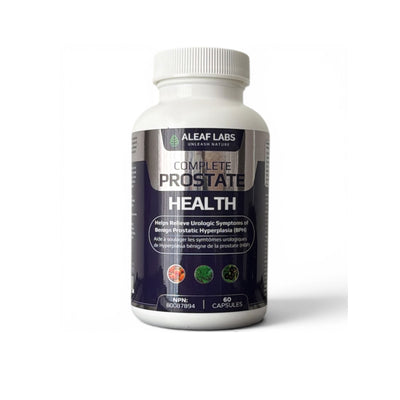
Complete Prostate Health is licensed by Health Canada under NPN 80087894 with this authorized claim:
“Used in Herbal Medicine to help relieve the urologic symptoms — weak urine flow, incomplete voiding, frequent daytime and night-time urination — associated with mild to moderate benign prostatic hyperplasia.”
It contains saw palmetto 200 mg (10:1), stinging nettle 80 mg (herb top, 10:1), pygeum 25 mg (2.5:1, 13% phytosterols), pumpkin fruit 50 mg, citrus bioflavonoids 30 mg and zinc 15 mg per capsule, two capsules daily.
Read that against the table above and you will notice our saw palmetto is at trial strength, our zinc sits at the top of its range, and our pygeum, nettle and pumpkin are below the doses used in the studies — and that our nettle is herb top rather than the root the trials used. We would rather you learned that here than worked it out yourself. Our full ingredient-by-ingredient breakdown, including where we fall short, is in the clinical ingredient review.
Related reading
- What causes weak urine flow in men? 7 evidence-based causes
- Supplements for frequent urination at night: what actually helps
- Does saw palmetto work? A balanced review of the evidence
- 10 signs of an enlarged prostate every man over 40 should know
- Best prostate supplement in Canada: what to look for
- Browse Health Canada-licensed men’s health supplements