Saw palmetto is the most widely used botanical supplement for prostate health globally. But the clinical evidence is weaker than most product labels suggest, and the most recent review of it, a 2024 Cochrane review, found little benefit from saw palmetto on its own. This article walks through what the research shows and how that conclusion was reached.
What Is Saw Palmetto?
Saw palmetto (Serenoa repens) is a lipophilic extract derived from the berries of a small palm native to the southeastern United States. The standardized extract, typically standardized to 85% or more total fatty acids, is the form used in clinical trials. Crude berry powder found in cheaper supplements has not demonstrated comparable efficacy and should not be conflated with standardized extract.
Proposed Mechanisms
- 5-alpha-reductase inhibition: Inhibits the enzyme that converts testosterone to DHT, the primary androgen driving prostate tissue growth in BPH
- Anti-inflammatory activity: Inhibits COX-1 and COX-2 enzymes, reducing prostatic inflammation
- Alpha-adrenergic antagonism: May reduce urethral tone and improve urine flow
- Anti-estrogenic effects: May inhibit estrogen receptors in prostate tissue
The Short Answer
On current evidence, saw palmetto taken on its own does little for most men's urinary symptoms. The largest and most recent review of the research, a 2024 Cochrane review, found little to no benefit over placebo. Earlier studies looked more promising, and the history below explains why the picture changed.
The Early, Positive Evidence
A systematic review by Wilt et al. in JAMA (2000) pooled 18 randomized trials in 2,939 men and found that saw palmetto improved urinary symptom scores and peak flow compared with placebo. Most of those trials were small, short (often under three months) and used varied products and measures, which limits how much weight they can carry.
A head-to-head trial by Debruyne et al. in European Urology (2002) found a standardized hexane-extracted saw palmetto performed about as well as tamsulosin, a prescription alpha blocker, over a year, with fewer ejaculation side effects. That trial had no placebo group, so it cannot show how much of either improvement was a placebo response, which is large in BPH studies.
PubMed: Wilt TJ et al. - Saw Palmetto Meta-Analysis (JAMA 2000)PubMed: Debruyne et al. - Standardized Extract vs Alpha-Blocker RCTThe Larger, Negative Trials
Two large, NIH-funded placebo-controlled trials then tested saw palmetto more rigorously. STEP (2006) gave 225 men 160 mg twice daily for a year. CAMUS (2011) gave 369 men escalating doses up to three times the usual dose for 72 weeks. Neither found any improvement in symptoms or urine flow over placebo.
Critics point out that both trials used one commercial extract rather than the hexane extract used in several positive European trials, and argue that extract quality explains the gap. That argument is reasonable but still unproven: no large, independent, placebo-controlled trial has yet shown any particular saw palmetto extract clearly outperforming placebo.
PubMed: Bent S et al. - STEP Trial (NEJM 2006)PubMed: Barry MJ et al. - CAMUS Trial (JAMA 2011)The 2024 Cochrane Review
The updated Cochrane review (Franco et al., published January 2024) looked at 27 studies covering 4,656 men. Its main findings:
- Saw palmetto alone: in 9 placebo-controlled studies (1,681 men), it improved the International Prostate Symptom Score (IPSS) by an average of 0.9 points. Men generally need a change of about 3 points before they notice a difference, so this is little to no real benefit.
- Combination products: formulas pairing saw palmetto with other plant extracts did somewhat better, about 2.4 points in 4 studies (460 men), but with less certain evidence.
- Safety: saw palmetto was well tolerated, with side effects similar to placebo.
The authors concluded that saw palmetto alone provides little to no benefit for men with urinary symptoms from an enlarged prostate.
Cochrane: Franco JVA et al. - Serenoa repens for LUTS/BPE (2024)Does Extract Quality Still Matter?
Yes, for a different reason. Analyses of commercial saw palmetto products have found wide variation in fatty acid content, and some contain far less than their labels suggest. Quality does not rescue the evidence above, but it does decide whether you are getting what the label says. Look for a licensed product (an NPN in Canada) with the extract type and dose printed. We explain how to read standardization claims in this plain-English guide.
Current Guideline Position
The American Urological Association does not recommend saw palmetto or any other dietary supplement for BPH, citing inconsistent evidence, and its May 2026 update keeps lifestyle changes and prescription medicines as the standard options. The European Association of Urology has historically been more open to plant extracts as an option for men who want to avoid drug side effects. For what the 2026 update says, and whether saw palmetto or anything else can shrink the prostate, see can an enlarged prostate shrink naturally?
AUA: Management of LUTS attributed to BPH (2026)The Verdict
Saw palmetto on its own is unlikely to make a noticeable difference for most men. It is safe, and combination formulas show a modest effect, so some men reasonably choose to try one. If you do, use a licensed product with the doses printed, give it 8 to 12 weeks, and score your symptoms with our IPSS calculator before and after so you can judge it on your own numbers. See your doctor first if your symptoms are new or getting worse.
Saw Palmetto in Complete Prostate Health
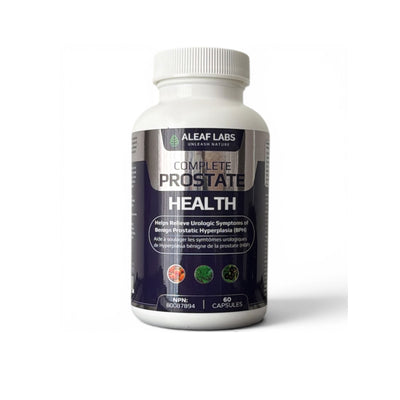
Complete Prostate Health by Aleaf Labs (NPN 80087894) is a saw palmetto prostate supplement: a 10:1 saw palmetto extract (200 mg per capsule, two capsules a day) in a six-ingredient Health Canada-licensed formula, alongside stinging nettle, pygeum, pumpkin fruit, citrus bioflavonoids and zinc. Every ingredient quantity is printed on the label, which is the only way to check any formula against the doses used in the trials above.
Two things worth knowing, given the evidence above. First, ours is a combination formula, the category where the Cochrane review found a modest effect, not saw palmetto alone. Second, our saw palmetto is a 10:1 concentrate (400 mg a day, above the 320 mg used in most trials), not an extract standardized to a fatty acid percentage, so it is not the same product tested in the European hexane-extract trials. Our clinical ingredient review sets out where each dose sits against the research.
Related reading
- Can an enlarged prostate shrink naturally? What the research and the 2026 AUA guideline say
- Pygeum (Prunus africana) for BPH: what 18 randomized trials actually found
- Complete Prostate Health vs. Super Beta Prostate: a clinical ingredient comparison
- Why men wake up to urinate at night: causes, science and solutions
- 10 signs of an enlarged prostate every man over 40 should know
- Browse Aleaf Labs Health Canada-licensed men’s health supplements