Urinary tract infections are among the most common bacterial infections in adults, and for many people they are not a one-time event. Recurrent UTIs, the antibiotic courses that follow, and the growing problem of antibiotic resistance make prevention a legitimate clinical question rather than a marketing one.
Cranberry and D-mannose are the two most-researched natural compounds for urinary tract support. This is a single, complete account of how each one works, what the trials actually found, what dose the research used, and where the evidence stops.
Why UTIs Happen: The Adhesion Step
Most UTIs are caused by Escherichia coli, a bacterium that lives harmlessly in the gut but causes problems in the urinary tract. E. coli carries hair-like surface structures called fimbriae that let it grip the cells lining the bladder wall. Once it grips, it multiplies, and the inflammation that follows is the infection you feel.
That adhesion step is the whole story, because it is the step both of these ingredients interfere with. If bacteria cannot attach, normal urine flow carries them out before they can establish anything.
Cranberry: What the Proanthocyanidins Do
Cranberry does not acidify urine and does not kill bacteria, despite both being widely repeated. Its active compounds are proanthocyanidins — specifically the A-type PACs that are unusually concentrated in cranberry — and they interfere with E. coli's ability to adhere to the urinary tract lining.
Cranberry reduces recurrent UTIs — in specific groups
The 2023 update of the Cochrane systematic review pooled more than 45 randomized controlled trials. It concluded that cranberry products reduce the risk of repeat, symptomatic, culture-verified UTIs, most clearly in three populations: women with recurrent UTIs, children, and people susceptible following a medical intervention.
This was a real change from the inconclusive 2012 review, and the reason matters: the newer trials used better designs and products standardized for their active compounds. The evidence is for standardized extract, not for juice.
Williams et al. — Cochrane 2023 (PMID 37068764)The effect tracks with PAC content
A 2010 multicentre randomized double-blind study tested this directly: participants took cranberry powder standardized to different PAC doses, and researchers measured how well their urine then prevented E. coli from adhering. The result was dose-dependent, with a meaningful anti-adhesion effect observed around 36 mg of PACs per day.
That figure is the reason standardization matters more than the milligrams on the front of the bottle. PAC content varies enormously between cranberry products, and juice is both dilute and heavily sugared.
Howell et al. — PAC dose-response (PMID 20470412)D-Mannose: The Decoy
D-mannose is a simple sugar found naturally in several fruits. Unlike glucose it is not significantly metabolised, so it passes largely unchanged into the urine — which is exactly where it needs to be.
The mechanism is elegant. The type 1 fimbriae E. coli uses to grip the bladder wall have a strong affinity for mannose. When D-mannose is present in urine, the bacteria bind to the free-floating sugar instead of to you, and are flushed out.
Comparable to a preventive antibiotic, with fewer side effects
A 2014 randomized controlled trial followed 308 women with recurrent UTIs, assigning them to 2 g of D-mannose powder daily, the antibiotic nitrofurantoin, or no preventive treatment. Over six months, about 15% of the D-mannose group had a recurrence, against roughly 20% on the antibiotic and about 60% with no treatment — with notably fewer side effects reported than the antibiotic arm.
Kranjčec et al. — RCT (PMID 23633128)Two later systematic reviews — a 2020 meta-analysis in the American Journal of Obstetrics & Gynecology and a 2021 review in European Urology Focus — both concluded that D-mannose appears to reduce recurrent UTI risk versus placebo, and both explicitly called for larger trials to confirm it. That caveat is theirs, and it is worth carrying: the direction of the evidence is consistent, the volume of it is still modest.
Why Use Both
The two ingredients interrupt bacterial adhesion by different routes. Cranberry PACs alter the bacterial surface so E. coli struggles to grip in the first place; D-mannose occupies the type 1 fimbriae directly, so the grip lands on a decoy. Combining them broadens the coverage rather than doubling one mechanism.
Combination formulas pairing cranberry and D-mannose, sometimes with probiotics, have reported improvements in urinary symptoms and quality of life in women with recurrent cystitis. Those studies are small, and the honest summary is that the rationale for combining is mechanistic and sound while the combination-specific trial base is thinner than the evidence for either ingredient alone.
Who the Evidence Actually Covers
- Women with recurrent UTIs. Two or more infections a year meets the definition of recurrent, and this is the group with the clearest supporting evidence for both ingredients.
- Post-menopausal women. Declining estrogen alters the vaginal microbiome and raises susceptibility.
- People who use catheters. Catheter-associated UTIs are a recognised clinical problem where cranberry supplementation has shown benefit.
One clarification worth making, because the internet blurs it: men with an enlarged prostate who do not empty the bladder completely are at raised UTI risk, and that is a real epidemiological fact. But the Health Canada licence for our product covers prevention of recurrent UTIs in women, and we are not going to stretch it past that. Men whose urinary symptoms come from the prostate should start with the prostate side of the problem instead.
What to Look For on a Label
- Standardized extract, not juice powder. The benefit tracks PAC content. Dried juice powder has variable and often negligible PACs.
- A clinically relevant D-mannose dose. Trials used 500 mg to 2 g daily. Token doses are unlikely to do anything.
- An NPN. In Canada, any product making a urinary health claim must be licensed by Health Canada, which reviews the ingredients, doses and exact claim wording before sale.
And a point against our own label while we are on the subject of standardization: our cranberry is stated as a 25:1 concentrate equivalent to 5,000 mg of fruit, which tells you the concentration but not the PAC percentage. The 36 mg/day figure above is the number the research is built on, and we do not currently print a PAC figure you could check it against. We would rather flag that ourselves than have you notice it.
When to see a doctor rather than order anything
Neither ingredient treats an active infection. Burning on urination, urgency, cloudy or strong-smelling urine, pelvic pressure — and especially fever or back or flank pain, which can indicate kidney involvement — need medical assessment. These are preventive tools for use between infections, ideally as part of a strategy discussed with your doctor.
What We Make, and What It Is Licensed to Say
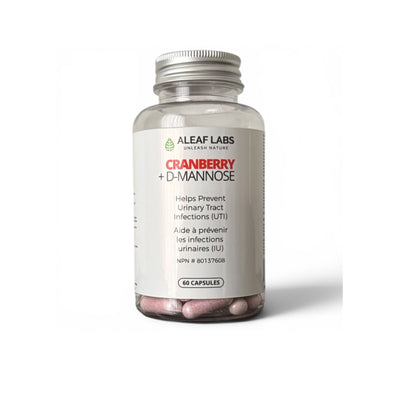
Cranberry + D-Mannose carries Health Canada NPN 80137608 and this authorized claim:
“Helps prevent (recurrent) urinary tract infections (UTIs) in women.”
Per capsule: D-mannose 300 mg and cranberry 200 mg at a 25:1 concentration, equivalent to 5,000 mg of cranberry fruit. One non-medicinal ingredient: the capsule itself.

Related reading
- Browse Health Canada-licensed urinary tract supplements
- Supplements for weak urine flow: what the evidence supports — for men, where the cause is usually the prostate
- Frequent urination in men over 40: 8 causes and what to do