An enlarged prostate — clinically known as benign prostatic hyperplasia (BPH) — is one of the most common conditions affecting men over 40. By age 60, more than half of all men have some degree of prostate enlargement. Yet many men don't recognize the early signs, or dismiss them as normal aging. Early awareness leads to earlier intervention, and earlier intervention means fewer complications.
How the Prostate Grows and Why It Matters
The prostate is a walnut-sized gland that surrounds the urethra — the tube that carries urine from the bladder out of the body. From birth through puberty, the prostate grows rapidly. It then remains relatively stable until around age 40, when a second growth phase begins, driven by hormonal changes including shifts in the testosterone-to-estrogen ratio and increased sensitivity to dihydrotestosterone (DHT).
As the prostate enlarges, it gradually compresses the urethra, restricting urine flow and forcing the bladder to work harder to expel urine. Over time, the bladder muscle can thicken and become overactive, producing the urgency and frequency symptoms that many men associate with an aging prostate.
↗ PubMed: Roehrborn CG — BPH Pathophysiology and Natural HistoryThe 10 Signs of an Enlarged Prostate
1. Weak or Reduced Urinary Stream
One of the earliest and most consistent signs of BPH is a noticeably weaker urinary stream. Men often describe it as a reduced force of flow, sometimes accompanied by a thin or split stream. This occurs because prostate tissue is compressing the urethra, narrowing the channel through which urine passes. Urodynamic studies measure peak flow rate (Qmax) — a Qmax below 10 mL/s is considered significantly reduced and is a key diagnostic marker for obstructive BPH.
2. Difficulty Starting Urination (Hesitancy)
Urinary hesitancy — the need to wait, strain, or bear down before urination begins — reflects the bladder's difficulty overcoming the resistance created by an enlarged prostate. Some men describe standing at the urinal for 30–60 seconds before flow begins. Hesitancy tends to worsen over time as obstruction increases.
3. Frequent Urination
Needing to urinate more than eight times in a 24-hour period is considered urinary frequency. In BPH, frequency arises from two mechanisms: incomplete bladder emptying (leaving residual urine that fills the bladder more quickly) and bladder overactivity triggered by chronic outlet obstruction. Frequency is one of the most disruptive symptoms of BPH for daily quality of life.
4. Nighttime Urination (Nocturia)
Waking one or more times per night to urinate is called nocturia. Waking twice or more per night is consistently associated with significant quality-of-life impairment, including sleep fragmentation, daytime fatigue, reduced cognitive performance, and increased fall risk in older men. Nocturia is reported by over 60% of men with BPH and is frequently the symptom that first prompts men to seek medical attention.
↗ PubMed: Irwin DE et al. — Nocturia Prevalence and Impact Study5. Urgency — Sudden Strong Urge to Urinate
Urinary urgency is the sudden, compelling need to urinate that is difficult to defer. In BPH, urgency arises from bladder overactivity — the bladder muscle becomes hypersensitive after years of working against increased outlet resistance. Urgency can lead to urge incontinence if the bladder contracts before a toilet is reached.
6. Feeling of Incomplete Bladder Emptying
Many men with BPH describe the persistent sensation that their bladder has not fully emptied even after urinating. This is often accurate: post-void residual (PVR) urine volume, measured by ultrasound, is frequently elevated in men with BPH. Significant PVR increases the risk of urinary tract infections and, in severe cases, can lead to bladder or kidney damage.
7. Dribbling After Urination (Post-Void Dribbling)
Terminal or post-void dribbling — the continued leakage of small amounts of urine after the main stream has ended — occurs when residual urine in the urethra is not fully expelled. It is a common but often underreported symptom of BPH due to the embarrassment it causes.
8. Intermittent or Interrupted Stream
An intermittent urine stream — where flow starts and stops repeatedly during a single void — indicates that the bladder is struggling to maintain consistent pressure against urethral resistance. It is distinct from hesitancy (difficulty starting) and reflects a more advanced degree of obstruction or bladder muscle fatigue.
9. Straining to Urinate
Actively bearing down or using abdominal muscles to initiate or maintain urine flow is abnormal and indicates significant urethral obstruction. Chronic straining increases intra-abdominal pressure and, over time, can contribute to hernia development and bladder diverticula.
10. Urinary Tract Infections (UTIs)
Men with BPH who have significant post-void residual urine are at increased risk for urinary tract infections. Stagnant urine is a growth medium for bacteria. Recurrent UTIs in an adult man without another obvious cause should prompt evaluation for underlying bladder outlet obstruction.
Symptom Scoring: The IPSS
The International Prostate Symptom Score (IPSS) is a validated 7-question questionnaire used by physicians worldwide to quantify BPH symptom severity. Scores range from 0 to 35:
- 0–7: Mild symptoms
- 8–19: Moderate symptoms
- 20–35: Severe symptoms
An IPSS of 8 or above generally warrants physician evaluation and discussion of treatment options. You can score yourself with our free IPSS calculator in about two minutes and take the result to your family physician or urologist.
↗ PubMed: Barry MJ et al. — IPSS Development and ValidationWhen to See a Doctor
You should see a physician promptly if you experience any of the following:
- Complete inability to urinate (acute urinary retention) — this is a medical emergency
- Blood in the urine
- Pain during urination
- Fever with urinary symptoms (possible UTI or acute bacterial prostatitis)
- Symptoms that are worsening progressively or significantly impacting your quality of life
For milder symptoms, a routine appointment with your family physician is the appropriate starting point. They will assess your IPSS, perform a digital rectal exam, and order a PSA test to help characterize the cause of your symptoms.
Natural Support for Prostate Symptoms
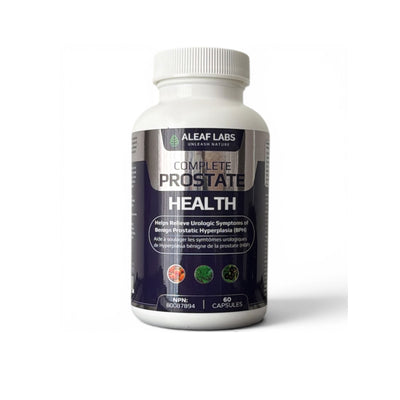
For men with mild to moderate BPH symptoms (IPSS 8–19), lifestyle modification and natural health products are often the first step before pharmaceutical intervention. Complete Prostate Health by Aleaf Labs is a Health Canada-licensed BPH supplement (NPN 80087894) combining six research-informed ingredients — saw palmetto (200 mg, 10:1), stinging nettle (herb top), pygeum, pumpkin (fruit), citrus bioflavonoids and zinc (15 mg) — formulated to support prostate and urinary function in men.
Wondering whether lifestyle changes or supplements can reverse the enlargement itself? We look at what the trials show in can an enlarged prostate shrink naturally?
Related Reading
- Can an Enlarged Prostate Shrink Naturally? — what the research and the 2026 AUA guideline say.
- What Causes Weak Urine Flow in Men — the seven causes behind the first sign on this list.
- Why Men Wake Up to Urinate at Night — nocturia and the mechanisms behind it.
- Frequent Urination in Men Over 40 — eight causes, including the ones that are not the prostate.
- BPH vs. Prostate Cancer — which symptoms separate the two, and which do not.
- Best Prostate Supplement in Canada — what to check on a label before buying one.