The short answer
Usually, no. An enlarged prostate rarely shrinks on its own or with natural remedies alone. But the symptoms often can get better, sometimes a lot. The only treatments shown in large trials to shrink the prostate are prescription drugs called 5-alpha reductase inhibitors (finasteride and dutasteride). They reduce prostate volume by about 20–25% over 6 to 12 months. Lifestyle changes and some plant extracts can ease the nightly trips to the bathroom and the weak stream. They do this without measurably changing prostate size.
That difference matters, because what most men want isn't a smaller gland. They want to sleep through the night and empty their bladder properly. Below we go through what the research shows for each approach, and what the American Urological Association's updated 2026 guideline recommends.
This article is for general education and is not medical advice. Urinary symptoms can have other causes, so talk to your doctor before starting or changing any treatment.
What BPH is, and why the prostate grows
Benign prostatic hyperplasia (BPH) is a non-cancerous enlargement of the prostate, and it's extremely common. Autopsy studies find it in about half of men in their 50s and close to 90% of men over 80. A healthy adult prostate is roughly the size of a walnut, about 20–25 mL.
The part that grows sits right around the urethra, the tube that carries urine out of the bladder. As it enlarges, it can squeeze that tube. That causes the classic symptoms (see the full list here): a weak stream, hesitancy, dribbling, and waking at night to urinate.
The main driver is dihydrotestosterone (DHT), a hormone made from testosterone by an enzyme called 5-alpha reductase. Age, family history, abdominal weight and metabolic factors such as blood sugar all play a part.
One surprising fact: prostate size and symptoms don't track closely. Some men with large glands have few symptoms, and some with modest glands have many. That's why doctors score symptoms rather than measure size alone. You can score your own with our IPSS prostate symptom calculator.
Can an enlarged prostate actually shrink?
Yes, but in trials only with medication. The landmark PLESS trial followed 3,040 men for four years. On finasteride, prostate volume fell by 18%, while in men taking a placebo it grew by 14%. Finasteride also roughly halved the risk of sudden urinary blockage or needing surgery. Dutasteride shows similar reductions of about 25%. Both take around six months to work fully, and a small share of men report sexual side effects.
No diet, exercise plan or supplement has been shown in good-quality trials to measurably shrink the prostate. What they can do is ease symptoms, through less inflammation, better bladder habits or relaxed muscle tone around the urethra.
| Approach | Shrinks the prostate? | Eases symptoms? | Strength of evidence |
|---|---|---|---|
| 5-ARI drugs (finasteride, dutasteride) | Yes, about 18–25% | Yes, slowly | Strong (large, long RCTs) |
| Alpha blockers (e.g. tamsulosin) | No | Yes, within days | Strong |
| Lifestyle and bladder habits | No | Yes, for many men | Moderate |
| Weight loss and exercise | Not shown | Lower risk of BPH and symptoms | Moderate (observational) |
| Plant extracts (saw palmetto, pygeum, nettle) | Not shown | Small to modest, varies by extract | Mixed |
| Procedures (TURP, newer options) | Removes or reduces tissue | Yes, often substantially | Strong |
Lifestyle changes with real evidence behind them
These are free, low-risk, and the first step in every major guideline. In a UK trial published in the BMJ (Brown et al., 2007), men taught a simple self-management program had fewer treatment failures and bigger symptom improvements over a year than men who were just monitored.
- Time your fluids. Drink normally during the day, but cut back in the 2 hours before bed.
- Cut caffeine and alcohol, especially in the evening. Both irritate the bladder and increase urine output.
- Double void. After urinating, wait 30 seconds and try again to empty fully.
- Retrain your bladder. When you feel urgency, try to hold on a few minutes longer, gradually stretching the interval.
- Move more. A meta-analysis of 11 studies and over 43,000 men linked regular moderate-to-vigorous activity with up to a 25% lower risk of BPH or urinary symptoms (Parsons & Kashefi, 2008).
- Lose abdominal weight. In the Baltimore Longitudinal Study of Aging, men with a BMI of 35 or more were about 3.5 times more likely to have an enlarged prostate.
- Review your medicines. Decongestants and some antihistamines can make it harder to urinate, so ask your pharmacist.
- Treat constipation. A full bowel presses on the bladder and urethra.
If night-time trips are your main problem, our guide to supplements for frequent urination at night covers more habits and what the research says.
Supplements: what the peer-reviewed research shows
The honest summary: plant extracts don't shrink the prostate. Their effect on symptoms ranges from small to modest, depending on the extract and the study.
Saw palmetto. This is the most-studied herb for BPH. A 2024 Cochrane review (27 studies, 4,656 men) found saw palmetto on its own made little to no difference to symptom scores, improving the IPSS by less than one point (Franco et al.). Products combining saw palmetto with other plant extracts did slightly better, improving scores by about 2.4 points in four studies. We cover this in depth in Does saw palmetto work?
Pygeum (African plum bark). An older Cochrane review of 18 trials (1,562 men) found men taking pygeum were about twice as likely to report overall symptom improvement, with night-time urination down by about 19%. The trials were small and short, so the evidence is moderate at best.
Stinging nettle root. A 6-month randomized trial in Iran of about 550 men found better symptom scores and urine flow than with a placebo. One trial isn't enough to call it proven. Note that the research used the root, not the leaf.
Pumpkin seed. The 12-month GRANU trial (1,431 men) gave mixed results: some measures improved, but its main pre-set comparison wasn't a clear win.
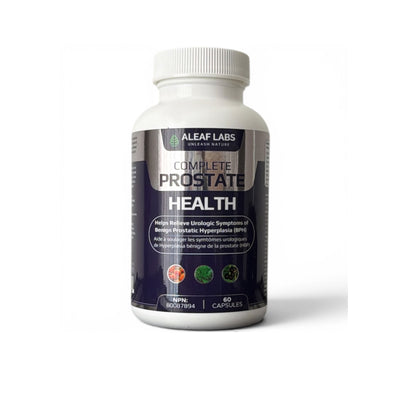
What this means for you: if you try a supplement, choose one licensed by Health Canada (look for an 8-digit NPN on the label). Check that the doses match the ones used in trials, give it 8–12 weeks, and track your IPSS score before and after. Our Complete Prostate Health (NPN 80087894) is licensed to help relieve urinary symptoms of BPH. It combines saw palmetto at trial strength with pygeum, nettle and pumpkin. We publish an ingredient-by-ingredient review that shows where our doses match the research and where they don't.
What the 2026 AUA guideline says
In May 2026 the American Urological Association released an updated guideline on BPH in three parts: evaluation, medical management and procedures. The headline change is philosophical: every recommendation now rests on shared decision-making between you and your doctor, rather than a one-size-fits-all treatment ladder.
What that means in practice:
- Lifestyle and behaviour changes remain first-line. Fluid timing, cutting caffeine, bladder training and weight loss are still where treatment starts.
- Alpha blockers and 5-ARIs remain the standard medicines. 5-ARIs are still the only drug class that shrinks the gland.
- New: low-dose daily tadalafil in combination. The guideline now supports pairing it with an alpha blocker, partly to protect ejaculatory function, or with finasteride.
- PSA testing is framed as a shared decision. It's no longer an automatic step; you and your doctor weigh the pros and cons.
- Procedures were re-sorted. TURP remains a standard. Some older heat-based procedures were dropped, and newer options have defined roles by prostate size.
On supplements, the AUA has long held that it can't recommend any dietary supplement or herbal product for BPH, given the mixed evidence. Published summaries of the 2026 update report no new supplement recommendation. If you choose to try one, tell your doctor, and treat it as one part of a plan rather than a replacement for proper evaluation.
When to see a doctor
See your doctor before self-treating any new urinary symptoms. BPH, infection, bladder problems and prostate cancer can start out feeling similar. A simple exam, urine test and possibly a PSA blood test can sort them out.
Get help the same day if you:
- can't urinate at all, or have painful bladder fullness
- see blood in your urine
- have fever, chills or burning with urination
- have pain in your lower back, side or pelvis that won't settle
Book a regular appointment if symptoms bother your sleep or daily life, your IPSS score is 8 or higher (moderate), or symptoms are getting worse despite lifestyle changes.
Frequently asked questions
Does BPH go away on its own?
The gland itself usually doesn't shrink without medication, but symptoms come and go. In many men they stay stable for years, especially with good bladder habits.
How long does it take for natural remedies to work?
Lifestyle changes can help within weeks. Plant extracts were tested over 8 weeks to 12 months, so give any supplement at least 8–12 weeks before judging it.
Can BPH turn into prostate cancer?
No. BPH isn't cancer and doesn't become cancer. But the two can exist together, which is why new symptoms should be checked by a doctor.
What is the fastest way to relieve BPH symptoms?
Prescription alpha blockers such as tamsulosin often work within days. Cutting evening fluids, caffeine and alcohol can help right away at night.
Does saw palmetto shrink the prostate?
No. The 2024 Cochrane review found saw palmetto on its own had little to no effect on symptoms, and trials haven't shown a meaningful change in prostate size.
Is walking good for an enlarged prostate?
Yes. Regular moderate activity such as brisk walking is linked with a lower risk of BPH and urinary symptoms, and it helps with weight, another risk factor.
The bottom line
You probably can't shrink an enlarged prostate naturally, but you can often make it much easier to live with. Start with the habits above and score your symptoms with the IPSS calculator. Then talk to your doctor about what fits your situation.
If you'd like to add a supplement to that plan, Complete Prostate Health is licensed by Health Canada (NPN 80087894) to help relieve urinary symptoms of BPH. It combines saw palmetto, pygeum, stinging nettle and pumpkin in two capsules a day. Track your IPSS score before you start and again at 12 weeks, so you can see for yourself whether it's working.
See Complete Prostate Health →
References
- Franco JVA, et al. Serenoa repens for the treatment of lower urinary tract symptoms due to benign prostatic enlargement. Cochrane Database Syst Rev. 2023;6:CD001423. Full review
- Wilt T, et al. Pygeum africanum for benign prostatic hyperplasia. Cochrane Database Syst Rev. 2002;(1):CD001044. PubMed
- McConnell JD, et al. The effect of finasteride on the risk of acute urinary retention and the need for surgical treatment among men with BPH (PLESS). N Engl J Med. 1998;338:557–63. PubMed
- McConnell JD, et al. The long-term effect of doxazosin, finasteride, and combination therapy on the clinical progression of BPH (MTOPS). N Engl J Med. 2003;349:2387–98. PubMed
- Brown CT, et al. Self management for men with lower urinary tract symptoms: randomised controlled trial. BMJ. 2007;334:25. PubMed
- Parsons JK, Kashefi C. Physical activity, benign prostatic hyperplasia, and lower urinary tract symptoms. Eur Urol. 2008;53:1228–35. PubMed
- Parsons JK, et al. Metabolic factors associated with BPH (Baltimore Longitudinal Study of Aging). J Clin Endocrinol Metab. 2006;91:2562–8. PubMed
- Safarinejad MR. Urtica dioica for treatment of benign prostatic hyperplasia: a randomized, double-blind, placebo-controlled, crossover study. J Herb Pharmacother. 2005;5:1–11. PubMed
- Vahlensieck W, et al. Effects of pumpkin seed in men with LUTS due to BPH in the one-year, randomized, placebo-controlled GRANU study. Urol Int. 2015;94:286–95. PubMed
- Berry SJ, et al. The development of human benign prostatic hyperplasia with age. J Urol. 1984;132:474–9. PubMed
- American Urological Association. Management of lower urinary tract symptoms attributed to BPH: AUA Guideline (2026). AUA announcement · AUA Daily News coverage