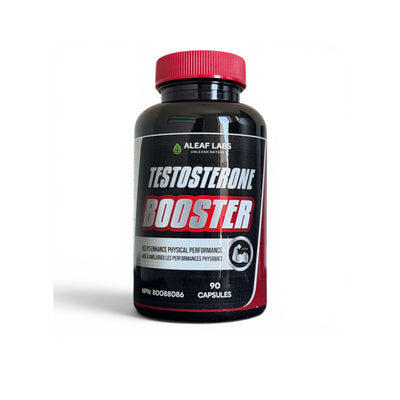
Tongkat ali is the most-studied ingredient in our Testosterone Booster, and it is also the one we get asked about most — usually some version of "does it actually work, and is it safe?" This article answers both questions using the published evidence, including the parts that do not flatter the ingredient we sell.
What Tongkat Ali Is
Eurycoma longifolia is a shrub native to Malaysia and Indonesia, used traditionally as a tonic. What is sold today is not the root itself but a concentrated extract of it, and the distinction matters more than almost anything else on the label — as you will see below, "tongkat ali" as a category tells you very little, because products vary enormously in what they actually contain.
The marker compound is eurycomanone, a bitter quassinoid. It is used as the reference standard partly because it is the most abundant active and partly because it carries the proposed mechanism. Laboratory work suggests eurycomanone inhibits aromatase — the enzyme that converts testosterone into oestradiol — rather than stimulating testosterone production directly. That distinction is worth holding onto: the proposed mechanism is about preserving testosterone, not manufacturing more of it. It is also preclinical work, not a demonstrated mechanism in humans.
↗ PubMed 23810842 — Low et al., eurycomanone and aromataseWhat the Human Trials Show
The strongest evidence is a 2022 systematic review and meta-analysis in Medicina. It is worth reading the numbers rather than the headline.
Nine studies were reviewed; five randomised controlled trials, totalling 232 men, entered the meta-analysis. Pooled effect on total testosterone was a standardised mean difference of 1.352 (95% CI 0.565–2.138, p = 0.001). In the subgroup of men who were hypogonadal at baseline, the effect was larger: SMD 1.861 (95% CI 0.719–3.002).
The authors' own conclusion was measured: the review "highlights the possible use of E. longifolia supplementation for enhancing testosterone production," while noting that "more research is required before its use in clinical practice."
↗ PubMed 36013514 — Leisegang et al. 2022, systematic review & meta-analysisFour Things That Meta-Analysis Does Not Tell You
Heterogeneity was very high — I² = 87%. That is a statistical measure of how much the individual trials disagreed with each other. At 87%, most of the variation between studies is not explained by chance. A pooled estimate drawn from trials that disagree this much is a weaker number than the confidence interval alone suggests.
Five trials, 232 men. That is a small evidence base by any standard. Of those five, the authors' own risk-of-bias assessment rated two as low risk, two as raising "some concerns," and one as high risk.
Eight of the nine studies used the same commercial extract — Physta, made by one Malaysian manufacturer — and at least one of those trials was funded by that manufacturer and co-authored by its employees. The review's authors framed this as a strength, since it removes variability between products. It is equally a limitation: almost everything known about tongkat ali in humans is known about one company's extract.
Free testosterone did not improve consistently, and there is no evidence of benefit in men whose testosterone is already normal. The larger effects came from men who were deficient at baseline. If your levels are in range, the trials do not support an expectation of change.
We sell this ingredient, so read that last paragraph twice. The honest summary is that tongkat ali has modest, real evidence for raising total testosterone in men who are low — and effectively none for men who are not. If your bloodwork is normal and you feel tired, the answer is probably sleep, stress, body composition or something a doctor should look at, not this capsule.
Dose: What Was Actually Studied
Every trial used a concentrated extract, not raw root powder, and the doses are in extract weight. The studied range runs from 100 mg to 600 mg per day, clustering around 200–300 mg.
| Trial | Daily dose | Duration | Population |
|---|---|---|---|
| Chinnappan 2021 | 100 mg and 200 mg | 12 weeks | Men 50–70, total T under 300 ng/dL |
| Tambi 2012 | 200 mg | 4 weeks | Late-onset hypogonadism (uncontrolled) |
| Leitão 2021 | 200 mg | 6 months | Men 40–59 |
| Ismail 2012 | 300 mg | 12 weeks | Healthy men 30–55 |
| George 2013 | 300 mg | 12 weeks | Healthy men |
| Henkel 2014 | 400 mg | 5 weeks | Male cyclists 57–72 (uncontrolled) |
| Chan 2021 | 600 mg | 2 weeks | Healthy men 18–30 |
Our Testosterone Booster provides 300 mg of Eurycoma longifolia root extract per day across three capsules. That sits squarely inside the studied range and matches two trials exactly. It is not a heroic dose and we are not going to present it as one — it is a normal, evidence-consistent amount.
One caution about how this ingredient is sold generally: many labels lead with a large quantity-crude-equivalent figure, which expresses how much raw root the extract represents. That number is not comparable to anything in the table above, because no trial dosed raw root. The comparable figure is extract weight, and extract weight is what we have used here.
↗ PubMed 23243445 — Ismail et al. 2012, 300 mg for 12 weeks ↗ PubMed 21671978 — Tambi et al. 2012What "1.5% Eurycomanone" Means
The extract used in nearly all the published trials is standardised to 0.8–1.5% eurycomanone and 40–65% glycosaponins. Ours is standardised to 1.5% eurycomanone and 40% glycosaponins, which sits at the top of that eurycomanone band.
That is a checkable, comparable specification, and it is the reason we print it. What it does not mean is that our extract is the same as the one in the trials. Extraction solvent, root source and the protein and polysaccharide fractions all differ between manufacturers, and only a full compositional match — or our own clinical data, which we do not have — would justify claiming equivalence. We are not claiming it.
For scale: one published trial used a water extract containing 0.0272% eurycomanone. That is roughly fifty-five times less than the standardised material. Two products can both say "tongkat ali" on the front and differ by that much.
Safety: The Liver Question
This is the part most tongkat ali articles skip, including our own previous version of this one. Here is the whole picture.
The US National Institutes of Health maintains LiverTox, a reference database on drug-induced liver injury. It has an entry for tongkat ali, updated October 2024, and assigns it a likelihood score of D — "possible rare cause of clinically apparent liver injury."
What sits behind that grade is thin. There is one published case report: a 47-year-old man who developed jaundice, dark urine and nausea about a week after starting a tongkat ali product, with peak ALT of 876 U/L and total bilirubin of 14.3 mg/dL. He improved after stopping it and was discharged within days. Other causes were investigated and ruled out.
But the report has real gaps, and LiverTox names them: it "lacked information on dose and had only partial follow up, not documenting whether full recovery occurred." The product was never chemically analysed — not for eurycomanone content, not for heavy metals, not for anabolic steroids.
LiverTox also raises the confounder directly. Reports of this kind have "largely been in young male body builders and the possibility of unacknowledged anabolic steroid use weakens the evidence that the injury was due to Eurycoma longifolia." It adds that patients "frequently do not admit to taking anabolic steroids and may specifically deny it."
So which is it — the herb, or a contaminated product?
Neither answer is established, and we are not going to pick the convenient one. Because the product in the only published case was never tested, "it must have been an adulterant" is a hypothesis, not a finding — and it would be self-serving for us to assert it. Equally, one case with no dose, no product analysis and incomplete follow-up does not establish that tongkat ali damages livers. NIH's own grade is "possible rare cause," and that is where the evidence currently sits.
One detail cuts slightly against the steroid explanation in this particular case: the patient was 47, not a young bodybuilder, and symptoms began within about a week. Anabolic-steroid liver injury usually takes one to three months to appear.
LiverTox adds one point that matters for who should take this: "Cases may be more frequent and more severe in patients with preexisting liver disease and most clinical studies of tongkat ali have excluded patients with preexisting liver disease." The reassuring safety record in the trials comes from trials that deliberately screened those people out.
There is also a single 2025 case report of new-onset atrial flutter in a 71-year-old man days after starting tongkat ali. One case, temporal association only — worth knowing about, not an established risk.
Safety: What European Regulators Concluded
In 2021 the European Food Safety Authority assessed Eurycoma longifolia root extract as a novel food, at a proposed use level of up to 200 mg per day — lower than the dose in most products, including ours.
EFSA declined it. An in vitro chromosome aberration test indicated clastogenic properties, and a follow-up in vivo comet assay was positive at the highest dose tested in tissues of first contact. The panel's conclusion, verbatim: the extract "has the potential to induce DNA damage, which is of concern," and "the safety of NF has not been established under any condition of use."
Three things need saying about that, and we are going to say all three.
It applies to an extract with the same specification as ours — EFSA characterised the material as glycosaponins 40–65%, eurycomanone 0.8–1.5%. This is not a distant relative of what we sell.
The in vivo positive was at 2,000 mg per kilogram of bodyweight, only in stomach and duodenal tissue. For a person taking 300 mg a day, that is several hundred times the equivalent exposure. Dose matters in toxicology, and this one is very large.
Two regulators reached different conclusions. EFSA says safety has not been established, and has not authorised it as a novel food in the EU. Health Canada licenses Eurycoma longifolia natural health products, including ours, under a pre-market review. "Not established" is not the same as "shown to be unsafe" — but it is not nothing either, and you are entitled to know it before you decide.
↗ PubMed 34987621 — EFSA NDA Panel 2021, novel food opinionThe Bigger Problem Is the Category
The most consistent finding in the tongkat ali literature is not about the plant. It is that products labelled tongkat ali frequently are not tongkat ali.
- A 2018 study used DNA barcoding on eleven retail products in Malaysia. Only four were authentic Eurycoma longifolia. Of those four, the ones tested for eurycomanone all fell below the Malaysian Standard minimum.
- A separate analysis of 41 products found 17 contained no detectable eurycomanone at all.
- A 2004 survey of 100 tongkat ali preparations found 36% exceeded Malaysia's mercury limit for traditional medicines. A 2003 survey of herbal preparations found 8% exceeded the lead limit.
- Regulators have found undeclared prescription erectile-dysfunction drugs in tongkat-ali-branded products. Singapore's Health Sciences Authority warned in 2009 about a product containing tadalafil concealed in the capsule shells.
Two honest notes on those contamination figures, because they are easy to misuse. The surveys date from 2003–2006 sampling in one market, and we found no comparable published survey since — so the current rate is unknown rather than known to be better. And those limits are concentrations in traditional preparations consumed at gram-scale doses. Health Canada sets limits by total daily exposure instead: under 20 µg of mercury and under 10 µg of lead per day. A 300 mg capsule would have to be extraordinarily contaminated to approach those ceilings.
The practical conclusion is not "be frightened." It is that identity, potency and contaminant testing are the things that separate one tongkat ali product from another, and that a regulated market is where you can expect them. That is what a Health Canada NPN represents: a formula reviewed before sale, with quality requirements attached. Ours is NPN 80088086, and you can look it up.
Who Should Not Take It
- Anyone pregnant or breastfeeding. Excluded from EFSA's target population; there is no human safety data.
- Anyone with liver disease. LiverTox notes cases may be more frequent and more severe, and the clinical trials excluded these patients.
- Anyone under 18. No trial evidence; the youngest studied populations were adults.
- Anyone taking propranolol. A randomised crossover study found E. longifolia reduced propranolol absorption — a 29% fall in total exposure and a 42% fall in peak concentration. Separate the doses, and speak to a pharmacist.
- Anyone using anabolic steroids or unverified bodybuilding stacks. This is the population the liver signal came from, and the one where nobody can tell what caused what.
- Anyone with a hormone-sensitive condition should ask their doctor first. This is precautionary reasoning from the proposed mechanism, not a documented harm.
Stop taking it and get liver tests if you develop jaundice, dark urine, pale stools, or unexplained nausea and abdominal pain.
The Bottom Line
In men who start with low testosterone, a standardised tongkat ali extract at 100–600 mg a day produces a modest, real increase in total testosterone. That case rests on one meta-analysis of five small trials in 232 men, with high heterogeneity, one trial at high risk of bias, and almost all the evidence generated on a single manufacturer's extract. Free testosterone did not move consistently, and there is no evidence of benefit if your levels are already normal.
On safety the honest position is uncertainty rather than reassurance. NIH grades it a possible rare cause of liver injury on the strength of a single case in which the product was never analysed. EFSA concluded in 2021 that safety has not been established, on genotoxicity grounds, at a dose lower than most products sell. Health Canada licenses it. Those findings coexist, and pretending otherwise would not serve you.
If you are going to take it, the most useful decisions are: buy from a market with enforced identity and contaminant testing, avoid it in pregnancy, liver disease and under 18, keep it away from propranolol, and get a blood test rather than guessing whether you are deficient in the first place.