Pygeum appears on the label of a large share of prostate supplements sold in Canada, usually in small print and usually without a number attached to it. It is one of the more thoroughly trialled botanicals in the category — and also one of the more thoroughly misrepresented, because the size of its evidence base is quoted far more often than the age and quality of it.
This article sets out what Prunus africana bark extract is, what the pooled randomized evidence found, what the reviewers themselves said about the limits of that evidence, what dose the trials actually used, and — at the end — how the dose in Aleaf Labs Complete Prostate Health compares. The last part is not flattering, and it is included for that reason.
What Pygeum Is
Prunus africana — the African cherry, or red stinkwood — is an evergreen tree of the montane forests of sub-Saharan Africa. The medicinal material is the trunk bark, from which a lipophilic extract is drawn. The characterised constituents fall into three groups: phytosterols (principally beta-sitosterol and its glucoside), pentacyclic triterpenoids such as ursolic and oleanolic acid, and ferulic esters of long-chain fatty alcohols.
The proposed mechanisms follow from that chemistry — anti-inflammatory activity in prostatic tissue, inhibition of fibroblast proliferation, and effects on bladder contractility demonstrated in animal models. Mechanistic plausibility is not efficacy, and the case for pygeum rests on the human trials, not the chemistry.
One thing most pages leave out
Prunus africana has been listed in CITES Appendix II since 16 February 1995, because bark harvesting for the medicinal trade — much of it historically destructive — put wild populations under pressure. Appendix II means international trade is permitted but regulated through export permits. It is a reasonable question to put to any brand selling pygeum, and a reasonable reason the ingredient is rarely cheap.
CITES — African cherry (Prunus africana)The Pooled Evidence: 18 Trials, 1,562 Men
The reference point for pygeum is a systematic review and meta-analysis published twice by the same group — in the American Journal of Medicine in 2000 (Ishani et al.) and as a Cochrane review (Wilt et al., 2002). Eighteen randomized controlled trials involving 1,562 men met the inclusion criteria. Seventeen were double-blinded.
What the pooled analysis reported
- Men taking pygeum were more than twice as likely to report an improvement in overall symptoms than men taking placebo — relative risk 2.1 (95% CI 1.4 to 3.1).
- Nocturia was reduced by 19%.
- Residual urine volume was reduced by 24%.
- Peak urine flow increased by 23%.
- On the combined outcome of urologic symptoms and flow measures, the effect size was −0.8 standard deviations (95% CI −1.4 to −0.3, from six studies).
- Adverse effects were mild and comparable to placebo. Overall dropout was 12% — 13% on pygeum, 11% on placebo.
What the Reviewers Said About Their Own Result
This is the part that gets quoted least, and it belongs in the same breath as the percentages above. The reviewers' stated conclusion was that a standardized preparation of pygeum may be a useful treatment option — followed immediately by four qualifications:
- The trials were small.
- They were short — mean duration 64 days, range 30 to 122 days. Benign prostatic hyperplasia is a condition measured in decades.
- They used varied doses and preparations, which is why a single pooled dose figure does not exist.
- They rarely reported outcomes using standardized validated measures of efficacy — many predate the IPSS becoming the field's standard instrument.
Two further limits are worth stating plainly. Only one of the eighteen trials reported a method of treatment allocation concealment. And no trial compared pygeum against an alpha-blocker or a 5-alpha-reductase inhibitor, so nothing in this evidence base speaks to how pygeum performs relative to prescription treatment. The reviewers called for exactly those comparisons; more than two decades later, they have largely not been run.
The Dose the Trials Used
The cleanest dose data comes from a 1999 trial in Urology (Chatelain et al.) that compared two schedules of the same extract: 50 mg twice daily against 100 mg once daily. Two hundred and nine patients completed the comparative phase. From a baseline IPSS of 17 in both groups, scores improved by 38% and 35% respectively — the two schedules performed alike.
Note what that trial does and does not establish. Its comparative phase had no placebo arm, so it demonstrates that once-daily and twice-daily dosing are equivalent, not that either beats placebo. That question belongs to the pooled analysis above.
The figure to carry away is the daily total: 100 mg per day of Prunus africana extract. That is the dose behind the better-documented trials in this literature.
Chatelain et al. — Urology 1999Pygeum and Saw Palmetto Are Not Interchangeable
The two botanicals are routinely listed side by side, as though they were two versions of the same thing. Their evidence bases have opposite shapes.
| Pygeum | Saw palmetto | |
|---|---|---|
| Number of randomized trials | 18 | More, and larger |
| Trial size and era | Small, mostly pre-IPSS | Includes large modern NIH-funded trials |
| Direction of the modern evidence | Untested — the modern trials were not run | Split; STEP and CAMUS found no separation from placebo |
| Compared head-to-head with prescription drugs | No | Yes, in at least one trial |
Pygeum's weakness is that its evidence stopped being generated before the field's methods matured. Saw palmetto's weakness is that when the field's methods did mature, two large trials failed to reproduce the earlier result. Neither is a settled case, and a formula containing both is making a bet on multiple mechanisms rather than standing on one proven ingredient. That reasoning is set out in full in Does Saw Palmetto Work?
What Is Actually in Complete Prostate Health
Here is the label figure, and the comparison that follows from it.
Pygeum — Prunus africana, trunk bark
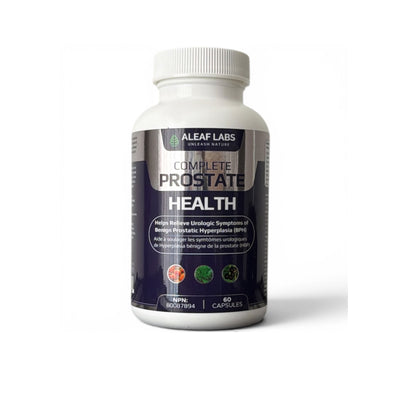
Complete Prostate Health (NPN 80087894) is taken as two capsules daily, which delivers 50 mg of pygeum extract per day.
That is half the 100 mg daily total used in the trials described above. The ingredient with the largest randomized evidence base in this formula is also the one where the dose sits furthest below the studied level — and no amount of favourable framing changes the arithmetic. Anyone buying a prostate supplement specifically for pygeum at trial strength should read the label before buying, this one included.
Why it is in the formula at all: pygeum contributes a distinct mechanism and a distinct phytosterol profile alongside saw palmetto at 400 mg per day, which is at trial strength. The formula is built on several partial contributors rather than one full-strength ingredient. Whether that trade is worth making is a judgement, not a finding, and the full dose-by-dose accounting is in the clinical ingredient review.
What Health Canada Licensed
Complete Prostate Health holds NPN 80087894. The authorized claim reads:
“Used in Herbal Medicine to help relieve the urologic symptoms — weak urine flow, incomplete voiding, frequent daytime and night-time urination — associated with mild to moderate benign prostatic hyperplasia.”
That sentence is the only outcome claim made for the product. An NPN is a pre-market authorization: Health Canada reviewed the formula, the ingredients, the doses and the exact wording of that claim before the product could be sold in Canada. The number is public record and can be looked up in the Licensed Natural Health Products Database.
Related Reading
- Complete Prostate Health: Clinical Ingredient Review — all six ingredients set against their trial doses, including the gaps.
- Does Saw Palmetto Work? — a balanced read of the most-debated ingredient in the category.
- Supplements for Weak Urine Flow — the evidence organised by symptom rather than by ingredient.
- Best Prostate Supplement in Canada — what to check on a label, and what an NPN does and does not certify.
- IPSS Symptom Score Calculator — the standard seven-question score, in about two minutes.